
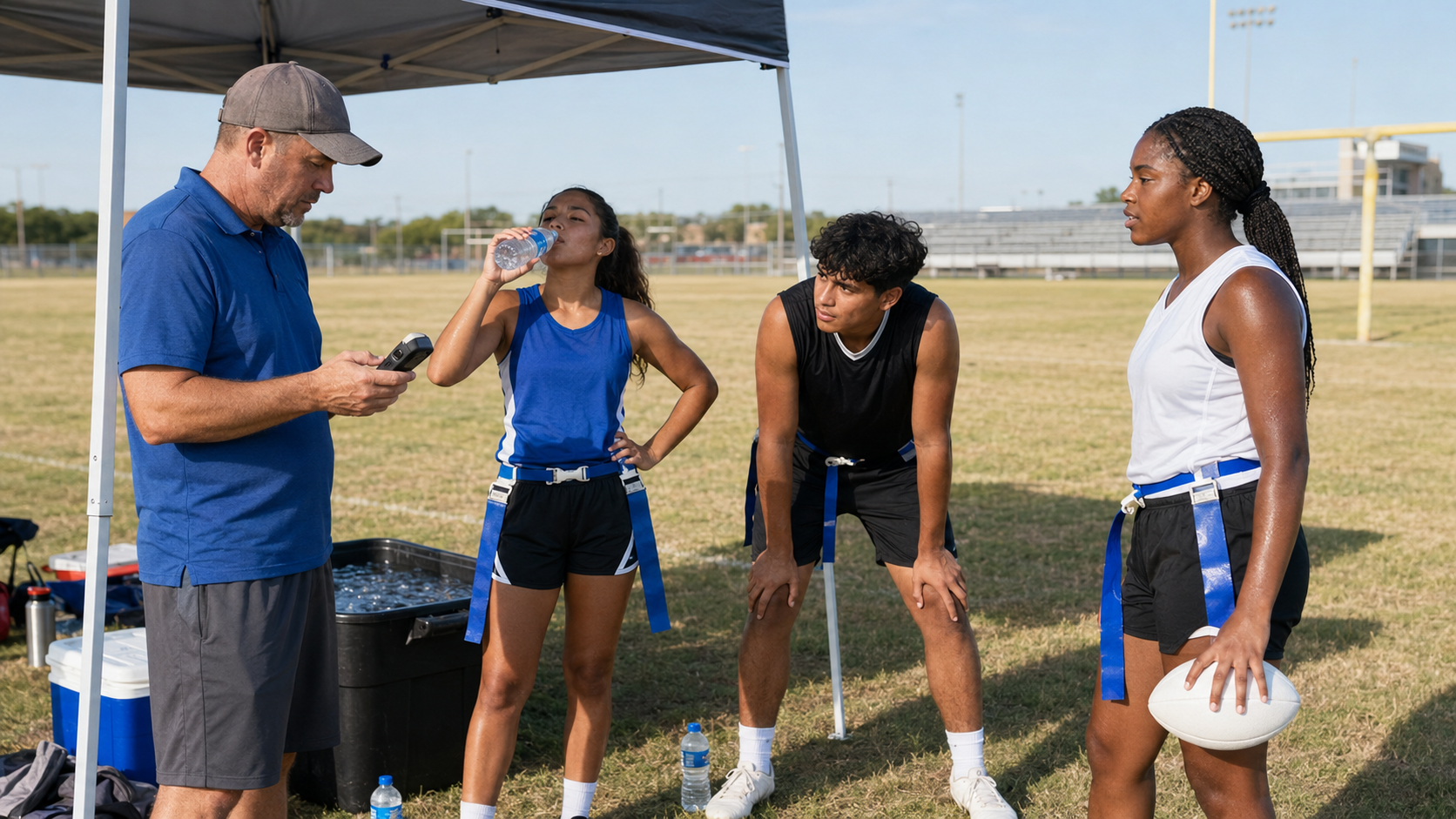
Texas Coaches: New UIL Heat-Safety Rules Are Now in Effect
August practices in Texas have always required coaches to take heat seriously. Beginning with the 2026–27 school year, that responsibility now includes a mandatory statewide monitoring standard for UIL outdoor activities.
Effective August 1, 2026, UIL member schools must use Wet Bulb Globe Temperature, commonly called WBGT, to monitor practice conditions and make activity changes based on the organization’s required heat guidelines.
For coaches, the change is bigger than checking the temperature before practice. It affects when conditions are measured, how often they are checked, when work and rest periods must change and when rapid-cooling equipment must be available.
This article provides a practical overview for coaches and program organizers. The official UIL Heat Stress and Athletic Participation Plan, your school district’s policies and guidance from your athletic trainer remain the controlling resources.
The New UIL Heat Rules at a Glance
- The rules took effect August 1, 2026.
- WBGT monitoring is now required for outdoor UIL athletic and marching band practices.
- A reading must be taken within 15 minutes before activity begins.
- Conditions must be checked every 30 minutes during practice or workouts.
- Practices must be modified when conditions reach more restrictive WBGT levels.
- Water access must remain unrestricted.
- Required rest breaks involve rest without activity and unlimited hydration.
- Rapid full-body cooling must be available when specified WBGT thresholds are reached.
- Practice limitations do not automatically apply to contests, but monitoring, emergency preparation and responsible game modifications are still expected.
What Changed on August 1?
The UIL began recommending WBGT monitoring in 2023. For the 2026–27 school year, it moved from a recommendation to a required standard for UIL outdoor athletic and marching band activities.
The goal is statewide consistency. Instead of relying only on the air temperature, schools now use an environmental measurement that better represents the heat stress an athlete experiences on the field.
The requirement applies to practices, conditioning sessions and workouts from the time participants report to the activity area until they leave it. The UIL heat-protocol FAQ also states that readings should be taken at outdoor practices, covered pavilions and indoor facilities that are not climate-controlled.
What Is WBGT?
WBGT is not the same as the temperature displayed in a weather app. It estimates heat stress using several environmental factors, including:
- Air temperature
- Relative humidity
- Wind speed
- Solar radiation and direct sunlight
That distinction matters in Texas. Two practices with the same air temperature may place different levels of heat stress on athletes because one field has more humidity, less wind or stronger direct sunlight.
Schools may use a scientifically approved on-site WBGT instrument or an approved internet-based forecasting resource. Coaches should confirm the measurement method, responsible staff member and documentation process with their athletic trainer or campus administration before the first outdoor session.
When Must WBGT Readings Be Taken?
UIL guidance establishes a clear monitoring schedule:
- Before practice: Take or check the WBGT reading within 15 minutes before activity begins.
- During practice: Check conditions every 30 minutes.
- When conditions change: Move to the appropriate activity level when the WBGT enters a more restrictive category.
- After practice: Keeping a record of the readings is recommended as a best practice, although the UIL FAQ says documentation is not currently required.
If an on-site instrument is used, the UIL says it should be positioned approximately 30 minutes before practice and read within 15 minutes of the start. The same person should take the readings throughout the practice window when possible.
Texas Uses Two WBGT Classes
The UIL guidelines divide Texas schools between Class 2 and Class 3 heat zones. Each class uses different WBGT thresholds because athletes in warmer regions may have different expected levels of heat acclimatization.
Do not guess your classification. Use the map and instructions in the official UIL plan or confirm the correct class with your district.
If a school sits near the boundary, the UIL says it should choose the appropriate classification before the school year, apply that classification consistently and avoid switching between classes based on which is more favorable on a particular day.
What Can Change as the WBGT Rises?
The required UIL activity chart uses progressive categories. As conditions become more restrictive, schools may need to change:
- The total length of practice
- The ratio of activity time to rest time
- The frequency and length of hydration breaks
- The amount of protective equipment worn
- The intensity or type of drill
- The start time or location of practice
- Whether outdoor activity can continue
Coaches should build more than one version of the day’s practice plan. A lower-intensity teaching period, shaded walk-through or indoor film session is easier to implement when it has already been planned.
Flag football does not use tackle equipment, but players still perform repeated sprints, changes of direction and high-intensity route work. A noncontact format does not remove the risk of heat illness.
Water Cannot Be Withheld
The UIL plan requires unrestricted access to water. Athletes should never be denied water, and required rest periods must include unlimited hydration and no activity.
That means a hydration break should not become extra coaching, conditioning, up-downs or a standing walk-through. Players need an actual recovery period.
Organize water before practice begins:
- Ask every player to arrive with a clearly labeled bottle.
- Provide a reliable refill source.
- Position water close enough that athletes do not lose most of the break walking to it.
- Keep backup cups or bottles available.
- Place water and shade near each small-sided practice area when possible.
When Is a Rapid-Cooling Zone Required?
A rapid-cooling zone is required for outdoor athletic activities when the WBGT reaches:
- 79.7 or higher for Class 2
- 82.0 or higher for Class 3
The zone must provide the ability to rapidly cool the full body using ice-water immersion. The UIL identifies options such as a cold-water immersion tub or an ice-water tarp capable of wrapping around an individual.
Shade, misters, ice towels and fans can support cooling, but the UIL FAQ says they do not replace the full-body immersion requirement. The school’s emergency action plan should identify who sets up the cooling area, who is trained to use it, how emergency medical services are activated and where the equipment will be located.
Do the Practice Rules Apply to Games?
The required practice limitations do not automatically apply to UIL contests. However, schools are still expected to monitor conditions, maintain a rapid-cooling zone when the applicable threshold is reached and make responsible safety modifications.
UIL examples include:
- Moving the start time
- Adding hydration opportunities or official timeouts
- Providing shade, misters, fans and ice towels
- Allowing teams to remain in air-conditioned areas until warmups
- Extending halftime for cooling and hydration
- Reducing sub-varsity quarter lengths when both schools agree
Flag football programs operating as district pilots, clubs or independent leagues should confirm which UIL, district and event policies apply to their practices and competitions.
Recognize When an Athlete Needs Help
Coaches are not expected to diagnose an athlete, but they must recognize warning signs and activate the school’s emergency plan.
The CDC lists headache, nausea, dizziness, weakness, irritability, thirst and heavy sweating among possible signs of heat exhaustion. Confusion, altered mental status, slurred speech, seizures, loss of consciousness or a very high body temperature can indicate heat stroke, a medical emergency.
If heat stroke is suspected, call 911, begin rapid cooling according to the emergency action plan and stay with the athlete until emergency personnel arrive. Review the CDC’s current heat-related illness symptoms and first-aid guidance with coaching staff before the season.
A Heat-Ready Flag Football Practice Plan
The exact practice length and work-to-rest ratio must follow the current UIL chart. Within those limits, coaches can organize flag football practices to reduce unnecessary waiting and repeated full-field running.
- Before athletes arrive: Set up the WBGT device or approved forecast, water, shade and rapid-cooling equipment when required.
- Opening period: Use a gradual dynamic warmup and short movement review.
- Skill stations: Divide players into small groups for passing, catching, snapping and controlled flag-pulling work.
- Teaching period: Install routes and defensive assignments at a walk-through pace.
- Competitive period: Use short, small-sided repetitions with clearly timed recovery.
- Scheduled checks: Assign one staff member to watch the clock and record the 30-minute WBGT readings.
- Closing period: End with a lower-intensity review rather than conditioning for conditioning’s sake.
Multiple footballs and organized equipment stations help more players receive repetitions without creating long lines. If one group is working, the other groups should be recovering, hydrating or completing controlled instruction, not running simply to stay busy.
Pre-Practice Checklist for Texas Coaches
- Confirm whether your location uses the UIL Class 2 or Class 3 chart.
- Review the current required WBGT activity guidelines.
- Assign the staff member responsible for readings.
- Take the first reading within 15 minutes before practice.
- Set alarms for each 30-minute recheck.
- Prepare an alternate lower-intensity or indoor practice plan.
- Provide unrestricted water access and real rest periods.
- Set up the required rapid-cooling zone when the threshold is reached.
- Review emergency roles and communication methods with staff.
- Count athletes before, during and after the session.
- Keep emergency contacts and relevant medical information accessible.
Keep the Equipment Side Organized
Heat safety depends on planning, monitoring and trained people, not a particular piece of flag football equipment. Still, an organized team bag can reduce wasted time and help practices move efficiently within required activity windows.
Before heading to the field:
- Sort complete flag belt sets by group or station.
- Test each flag attachment before practice.
- Bring enough footballs to operate several small-group drills.
- Use cones or markers to keep stations compact and close to water.
- Carry spare flags and belts so a broken piece does not delay the session.
GT offers individual and 10-piece flag belt sets, footballs in multiple age-based sizes and complete team packages for school, recreational and competitive programs.
The Bottom Line
The new UIL requirements make heat preparation a documented part of running outdoor practices in Texas. Coaches need a correct WBGT classification, a reliable monitoring method, flexible practice plans, unrestricted hydration and an emergency setup capable of rapid full-body cooling.
Check conditions, follow the current UIL chart and make the safer decision when athletes or the environment show that a plan needs to change.
Read more
The biggest story from the 2026 NFL FLAG Championships was not only who won. It was how large, competitive and international youth flag football has become. More than 350 girls’ and boys’ teams ar...

Every flag football player needs a properly fitted flag belt before they step onto the field. But when you are ordering equipment for an entire team, buying exactly one belt per player can leave yo...